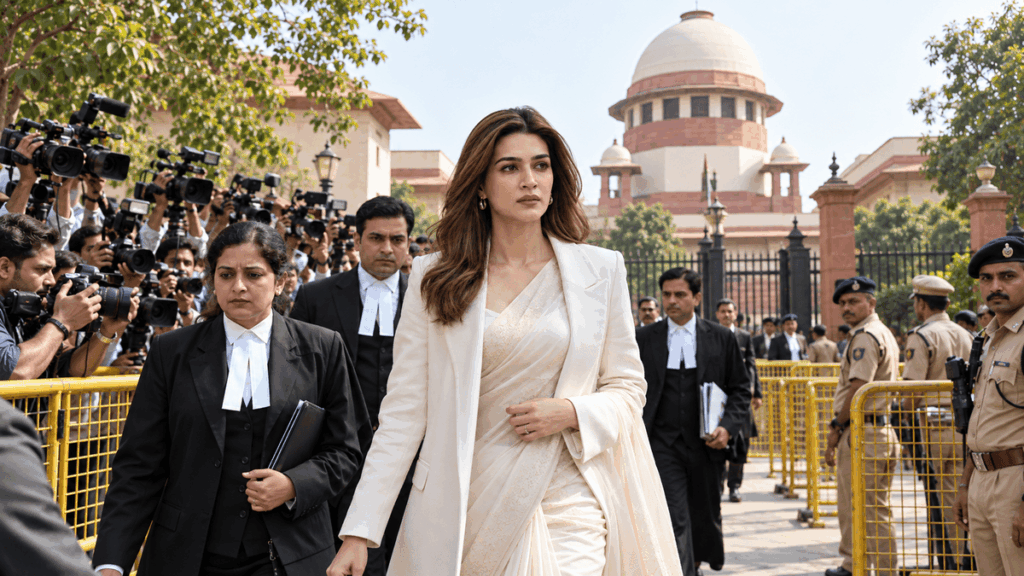
Bollywood actor Kriti Sanon has approached the Delhi High Court seeking protection of her personality rights, bringing renewed attention to a rapidly developing legal question in India: can someone’s face, voice, name or likeness be protected from unauthorised use, particularly when artificial intelligence can reproduce those attributes with increasing accuracy?
The matter came before Justice Purushaindra Kumar Kaurav on October 16, 2026. Rather than immediately passing a broad protective order, the Court asked Sanon’s counsel to provide relevant judgments, research papers and legal material explaining the scope of personality rights. The matter is reported to be listed next for October 29, 2026.
The case comes at a time when AI-generated images, voice cloning, face swapping and deepfake videos have made it possible to create highly realistic content appearing to feature celebrities without their participation or consent.
That creates an important question not only for celebrities but also for brands, advertisers, social-media users and AI-content creators:
When does an AI-generated image, video or cloned voice stop being creative content and become an infringement of someone’s personality rights?
Why Has Kriti Sanon Approached the Delhi High Court?
The primary reason behind Kriti Sanon’s case is the protection of her identity and commercially valuable personality attributes from unauthorised exploitation.
During the October 16 hearing, Sanon’s counsel, Advocate Pravin Anand, explained that personality rights can extend to attributes including a person’s:
- Name
- Voice
- Face
- Image
- Photograph
- Videos featuring the person’s face
- Other characteristics closely associated with their identity
Counsel also submitted that commercialising someone’s face or personality for monetary gain without consent or authorisation can fall within the scope of personality-rights protection.
Reports on the petition state that Sanon is seeking safeguards against unauthorised use of her name, photographs, likeness and other identifiable attributes, including misuse connected with AI-generated content and digital impersonation.
This distinction is important.
It would be premature to say that the Delhi High Court has already found that a particular deepfake of Kriti Sanon violated her rights. As of October 16, 2026, the Court is still examining the legal scope of her claim.
What Happened in Court on October 16?
At the hearing, Justice Purushaindra Kumar Kaurav asked an important preliminary question: what exactly falls within the parameters of personality rights?
Sanon’s lawyer explained that the concept includes attributes such as a person’s voice, face, name, image, photographs and videos, particularly where those attributes are commercially exploited without permission.
The Court then asked counsel to submit a compilation containing relevant judicial precedents, research papers and an explanation of the legal principles surrounding personality rights.
The Court indicated that it would examine this material before passing a more comprehensive order.
Reports also indicate that the Court is examining broader legal questions surrounding such cases, including the extent of protection available and the jurisdiction of the Delhi High Court’s Intellectual Property Division in personality-rights disputes.
Case Status as of October 16, 2026
At the time of writing:
October 16, 2026: Kriti Sanon’s personality-rights plea came before the Delhi High Court.
Court’s concern: The Court sought greater clarity on exactly what constitutes a personality right.
Direction: Sanon’s counsel was asked to provide relevant judgments, research material and legal submissions.
Final decision: No final ruling on Kriti Sanon’s personality-rights claim has been reported as of October 16.
Next reported hearing: October 29, 2026.
Therefore, headlines suggesting that Kriti Sanon has already “won” protection against all AI or deepfake content would go beyond what has happened in the case so far.
What Are Personality Rights?
Personality rights, sometimes discussed alongside publicity rights, generally concern an individual’s ability to control unauthorised exploitation of identifiable aspects of their persona.
For a celebrity, these attributes can carry considerable commercial value.
Imagine an advertisement showing Kriti Sanon apparently recommending a beauty product even though she never participated in the advertisement.
Or consider an AI-generated video reproducing her face and cloned voice to make it appear that she endorses a cryptocurrency platform.
The person creating such material may potentially benefit from the celebrity’s reputation without entering into an endorsement agreement.
That is one of the central concerns personality-rights law attempts to address.
India does not currently have one standalone statute comprehensively defining every aspect of “personality rights.” Instead, protections have developed through court decisions and related principles involving privacy, publicity, passing off, trademark, copyright and protection against reputational harm.
This is one reason the Delhi High Court’s request for detailed research in Sanon’s case is significant. The Court is examining how far the right should extend rather than automatically treating every use of a celebrity’s name or image as unlawful.
Can AI Deepfakes Violate Personality Rights?
Yes, they potentially can.
Indian courts have already recognised in other personality-rights cases that technologies including artificial intelligence, generative AI, machine learning, deepfakes and face morphing can be used in ways that infringe a person’s protected identity.
The legal problem is not simply that AI was used.
The more important questions are what the AI-generated material does, how the individual’s identity is being used, whether consent exists, whether commercial benefit is involved, and whether the content causes deception or reputational harm.
For example, an AI deepfake may raise serious personality-rights concerns if it:
- Falsely makes a celebrity appear to endorse a product or service.
- Uses the celebrity’s image to sell merchandise without authorisation.
- Clones a person’s voice for advertisements or promotions.
- Creates fake social-media accounts impersonating that person.
- Places the individual in fabricated or offensive situations.
- Uses a recognisable likeness to generate commercial traffic or revenue.
- Creates misleading content that viewers could reasonably believe is authentic.
Delhi High Court orders in previous celebrity cases demonstrate that courts are increasingly willing to address exactly these forms of technological impersonation.
The Anil Kapoor Case Is an Important Example
One of India’s most significant personality-rights decisions involving AI came in Anil Kapoor v. Simply Life India & Ors.
In September 2023, the Delhi High Court granted interim protection to actor Anil Kapoor against unauthorised exploitation of attributes connected with his personality.
The order specifically dealt with technological misuse involving artificial intelligence, machine learning, deepfakes and face morphing, among other techniques.
This precedent is important for the current debate because it demonstrates that AI-generated manipulation is not outside the reach of existing legal remedies simply because the technology itself is new.
Delhi High Court Has Continued Addressing AI Impersonation
More recent Delhi High Court orders reinforce this direction.
In a 2026 personality-rights proceeding involving actor Varun Dhawan, the Court issued interim restraints covering the unauthorised use of his name, image, voice and likeness through technologies including AI, generative AI, deepfakes, AI chatbots and face morphing for commercial or personal gain.
The Court also dealt with AI-generated or manipulated material capable of damaging the actor’s public persona.
Other orders have similarly recognised that false, obscene, morphed or distorted AI-generated content can implicate personality rights, reputation and privacy.
These decisions provide important context for Kriti Sanon’s case, although each case ultimately depends on its own pleadings, defendants, evidence and requested relief.
Why AI Has Made Personality Rights More Important
Celebrity impersonation existed long before generative AI.
What AI changes is scale, speed, cost and realism.
Creating a reasonably convincing fake celebrity endorsement once required advanced visual-effects skills. Today, generative tools can potentially produce cloned voices, altered photographs and synthetic videos far more quickly.
Three particular issues make this legally significant.
1. Fake Endorsements
Celebrities can charge substantial sums to endorse products.
If a business uses AI to make it appear that an actor has endorsed its product without permission, it may obtain commercial value from that celebrity’s reputation without paying for or receiving authorisation.
Consumers may also be misled into purchasing a product because they believe the endorsement is genuine.
2. Voice Cloning
Personality is not limited to someone’s face.
A celebrity’s distinctive voice can itself be commercially valuable and recognisable.
AI systems capable of synthesising realistic speech therefore raise similar questions. An advertisement using a cloned celebrity voice may create the impression that the celebrity participated in or approved the campaign even when they did not.
3. Deepfake Videos
Deepfake technology can place someone’s face onto another person’s body or generate synthetic footage depicting conduct that never happened.
The damage can go far beyond lost endorsement revenue.
Such content may affect privacy, dignity, reputation and public trust.
Once a convincing fake spreads across social networks, distinguishing the original from manipulated copies can become extremely difficult.
But Is Every AI Image of a Celebrity Illegal?
No.
This is one of the most important distinctions in the personality-rights debate.
A celebrity being famous does not necessarily give them an unlimited right to prohibit every mention, photograph, meme, caricature, commentary or creative reference involving them.
Courts must balance personality and privacy interests against legitimate expression.
The context of the use matters.
There can be important differences between:
Commercial exploitation: Using someone’s likeness to sell a product.
False endorsement: Making consumers believe the celebrity supports a business.
Impersonation: Pretending to actually be that person.
Defamatory or obscene deepfakes: Manipulated content capable of damaging dignity or reputation.
and legitimate uses such as:
News reporting
Criticism
Commentary
Parody
Satire
Artistic expression
Certain forms of fan-created content
The precise boundaries remain an evolving legal question in India.
That is partly why the Court’s decision to seek wider legal research in Kriti Sanon’s case is worth watching.
A personality-rights framework that is too weak could leave public figures vulnerable to AI impersonation.
One that is excessively broad could create problems for journalism, satire, commentary and legitimate creative expression.
Why Kriti Sanon’s Case Matters Beyond Bollywood
The consequences of this debate extend far beyond actors.
The same technology can be used to imitate:
- Business leaders
- Athletes
- Influencers
- Journalists
- Politicians
- Doctors
- Content creators
- Financial experts
- Ordinary citizens
Consider a fake video showing a financial expert recommending an investment scam.
Or a cloned CEO voice instructing an employee to transfer money.
Or an AI-generated advertisement falsely showing a doctor endorsing a health product.
The underlying problem is the same: technology is capable of separating an individual’s identity from that person’s actual consent.
That makes identity itself a growing area of digital-rights law.
Could Deepfake Creators Face Legal Consequences?
Potentially, yes.
Depending on the facts, an aggrieved person may seek remedies such as an injunction preventing further use, removal or blocking of infringing material, restrictions on unauthorised commercial exploitation and other appropriate relief.
The precise legal route depends on what has occurred.
A commercial deepfake, a defamatory video, trademark misuse, privacy violation and online impersonation may raise different causes of action.
Platforms and intermediaries can also become important where harmful content must be identified and removed.
Courts have increasingly used orders covering unknown defendants, sometimes called John Doe or Ashok Kumar defendants, where the identity of every infringer cannot initially be determined.
What Could Happen Next in Kriti Sanon’s Case?
The immediate development to watch is the hearing scheduled for October 29, 2026.
Sanon’s legal team is expected to place before the Court the judgments and research requested at the October 16 hearing.
The Court may then have a stronger basis to determine:
- Which elements of Sanon’s personality deserve protection.
- How broadly any injunction should operate.
- How AI-generated and manipulated content should be treated.
- What constitutes unauthorised commercial exploitation.
- Whether different kinds of defendants require different remedies.
- How such protections should coexist with lawful speech and expression.
- How personality-rights litigation fits within the Court’s jurisdictional framework.
However, until the Court passes its next order, the eventual scope of relief should not be predicted as a certainty.
What Brands and Content Creators Should Learn From the Case
Kriti Sanon’s petition also carries a practical warning for marketers.
Using a celebrity’s photograph simply because it is available online does not necessarily mean it is free to use for advertising.
The same principle becomes even more important with generative AI.
Creating a synthetic celebrity endorsement rather than taking an existing photograph does not automatically avoid legal risk.
Businesses using AI should therefore consider questions such as:
Do we have permission to use this person’s likeness?
Could viewers reasonably believe this person endorsed our product?
Are we cloning a recognisable voice or appearance?
Is the content being used to generate commercial revenue?
Is the AI material clearly fictional, satirical or transformative, or is it presented as authentic?
With AI-generated marketing becoming easier to produce, consent and transparency are likely to become increasingly important.
A Bigger Question for Indian Law
Kriti Sanon’s case arrives during a period in which the Delhi High Court has considered personality-rights claims involving numerous well-known individuals.
Courts have therefore been developing the law gradually, case by case.
Generative AI creates a new challenge because photographs, voices and videos no longer require the real individual to participate.
Someone’s digital likeness can effectively operate independently from the person it represents.
That raises a fundamental question:
Who controls your identity when technology can reproduce it without you?
Kriti Sanon’s case may help the Delhi High Court further clarify the answer.
Conclusion
Kriti Sanon’s approach to the Delhi High Court is part of a much larger legal debate about identity, consent and artificial intelligence.
Her counsel has argued for protection of attributes such as her name, face, voice, image, photographs and videos against unauthorised commercial exploitation. The Court, rather than immediately defining the limits of those rights, has asked for detailed judgments and research before considering a comprehensive order.
As of October 16, 2026, the case remains pending, and the next reported hearing is October 29, 2026.
The broader legal direction, however, is already becoming clearer.
AI technology does not automatically make the use of another person’s identity lawful. Where deepfakes, cloned voices or synthetic images exploit a person’s identity without consent, falsely imply endorsement, cause reputational harm or commercially appropriate their persona, personality-rights claims can arise.
At the same time, courts must ensure that protection of celebrity identity does not become a blanket prohibition against legitimate journalism, criticism, satire, parody and expression.
That balance may make Kriti Sanon’s personality-rights case one of the important cases to watch as Indian courts adapt existing legal principles to the age of generative AI.
Research Sources
1. LiveLaw, October 16, 2026
“Bollywood Actor Kriti Sanon Moves Delhi High Court Seeking Protection Of Her Personality Rights”
Used for details of the October 16 hearing, Justice Purushaindra Kumar Kaurav’s observations, submissions made by Advocate Pravin Anand, the request for judgments and research material, and the October 29 next-hearing date.
2. Mint / ANI, October 16, 2026
“Kriti Sanon personality rights case: Delhi High Court seeks compilation of judgments and legal research”
Used to cross-check the Court’s request for a comprehensive examination of personality-rights principles and questions concerning the Intellectual Property Division.
3. The Indian Express, October 16, 2026
“Kriti Sanon moves Delhi HC for personality rights protection, court seeks wider legal clarity”
Used for additional reporting on the wider context involving AI-generated material, deepfakes and unauthorised exploitation of celebrity identity.
4. Moneycontrol, October 16, 2026
“Kriti Sanon moves Delhi HC to protect her personality rights against AI deepfakes and identity misuse”
Used for reporting that Sanon’s requested safeguards concern her name, photographs, likeness, identifiable attributes and AI-generated identity misuse.
5. Delhi High Court, Anil Kapoor v. Simply Life India & Ors.
Used as primary judicial material showing how the Delhi High Court has addressed personality-rights misuse involving artificial intelligence, machine learning, deepfakes and face morphing.
6. Delhi High Court, Varun Dhawan personality-rights order, 2026
Used as primary judicial material illustrating more recent restrictions involving AI, generative AI, machine learning, deepfakes, AI chatbots and face morphing.
Research note: This article reflects publicly available information as of October 16, 2026. Since Kriti Sanon’s case is pending and the next reported hearing is October 29, the factual and legal position may change after subsequent court orders.